


































Radar chart trap

In our company, people think a lot about how to present figures well. ‘Well’ means that everybody is able to quickly grasp what they mean. That gives us more time to brood over their impact.

Things become difficult when it comes to radar charts.
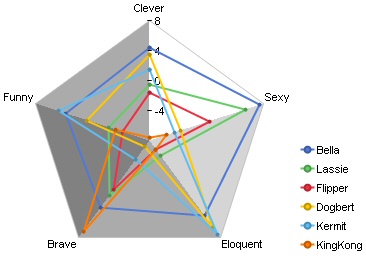
Radar chart

The same data is much better off in a graphical table. The most important fact emerges immediately: I am always above average!
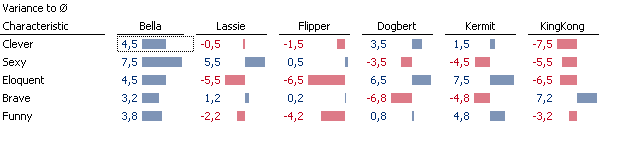
Graphical table

Here at the office, they make software that draws these tables automatically. In Excel you would use the Repeat function. That’s quite simple: a vertical bar is repeated as many times as the corresponding data value prescribes. That yields a nice bar inside the cell. You can even label it if you concatenate the value with the “&” character. Here is a sample how that works.

  • del.icio.us
  • Technorati
  • Furl
  • Netvouz
  • Ma.gnolia
  • Blue Dot
  • Digg
  • MisterWong
  • YahooMyWeb
  • Simpy

5 Responses to “Radar chart trap”

  1. Diana Says:

    Hate to break it to you Bella, but some of us like to use spiderweb charts because:
    a) it’s fun to use colors every so often and feel like you’re letting your hair down and the artist inside, out; and b) when you’re trying to explain data to people who’s eyes glaze over at the mere mention of the words “statistically significant” a spiderweb chart gives them something to look at and pretend to analyze while you explain why your basic technocentric customers are not price-driven and thus, are more likely to buy the more expensive but sophisticated (fill in the blank) than the plain vanilla customers (my absolute favorite customers because they pay religiously, never complain and never cancel) who cannot be considered part of the potential market for the new, really sophisticated product that the CEO is so excited about because they couldn’t figure out how to use it to save their lives. However, if you tweak the product to satisfy the needs of the high-usage, relatively sophisticated segment, you not only hit critical mass in the targeted areas, you can actually improve the margin. And , voilà, you just got yourself a sale, courtesy of the spiderweb chart. By the way, nice head shot

  2. Jesus Zuñiga Says:

    Radar Chart works well if yoy introduce a “benchmark” to see in each category who is above and who is bellow. I agree that for simple comparative purposes, bars work ok.

  3. Jesus Zuñiga Says:

    On second thoughts, maybe the example used is not suitable for radar charts. The same objective could be achieved through the use of line graphs (not bars) with more clarity and giving the alternative advantages that Diana describes in her comment. Maybe somebody that uses this graphs succesfully can give an example where they proof effective to comunicate a situation or support a decision. I can not imagine any aplication for this graphs on financial information.

  4. Diana Says:

    I don’t have an answer. I actually have a question. I need to report some data that I think is best represented in a radar chart but I’m not great at explaining what I see very clearly so I may be totally mistaken. This info is very simple. It consists of how certain customers rank on five different but interrelated attitudinal metrics. I need people to be able to compare them to see how they actually behave differently in something other than their actual telecom usage (which is what I usually use and it is very difficult to grasp unless you are thoroughly inmersed in it). The metrics I am using are their rankings on early adoption, traditionalism, price sensitivity, status consciousness and how hesitant they are when purchasing something new. You need to see them all together to get a picture of each type of customer. In order to minimize confusion, I planto break the data up so there are no more than three compared segments on each graph. Given that Bella stated clearly that this graph is a total waste of time and I really want people to get what I’m saying, my questions are: is this the best way to portray this information? What is the maximum number of segments I can put on a graph without losing clarity? Do I need to put the average scores on each graph so you can see not only how these segments or types of customers compare against each other but also how much they differ from the norm?
    Thanks a million!

  5. Peter Says:

    Seems German MIS expert Prof. Rolf Hichert doesn’t like spiderweb charts either.

Leave a Reply